


Container Deposit Schemes in Australia: What Each State Accepts
By Banish Australia · Published · Updated
Last updated: May 2026. We review this guide regularly so the dates, refund amounts and operator names stay accurate.
Every state and territory in Australia now runs a container deposit scheme. You drop off an eligible drink container at a collection point, and you get 10 cents back. The price is the same everywhere. The scheme names, operators and accepted container lists are not.
This is the complete guide to how containers for change work in Australia, with a clean state-by-state comparison table, links to every state scheme, and a plain-English breakdown of what your container deposit scheme will not refund (and what to do with those leftover caps and labels).
How does Containers for Change work?
The mechanics are the same in every state, even when the marketing name differs.
- A 10-cent deposit is added to the price of eligible drink containers when they are manufactured or imported. You pay it at the checkout, baked into the shelf price.
- When you finish the drink, you keep the container empty, unbroken and with the label still attached.
- You take it to a refund point. That might be a reverse vending machine (the bin-shaped TOMRA or Envirobank machines you see at shopping centres), a depot, or a bag-drop service.
- You get the 10 cents back per container, either as cash, an electronic transfer to your bank, or a donation to a registered charity or sports club.
Some operators let you bulk-scan a whole bag at a depot. Others want you to feed containers in one at a time at a machine. The refund is the same either way.
10 cent refund Australia: which containers are eligible?
Most schemes accept drink containers between 150 millilitres and 3 litres made from:
- Aluminium (soft drink cans, beer cans, energy drinks, pre-mixed spirits)
- Glass (beer bottles, soft drinks, kombucha, cider, water)
- PET plastic (water bottles, juice, sports drinks, soft drinks)
- HDPE plastic (some juice bottles, dairy-free milks)
- Liquid paperboard (juice poppers, flavoured milk cartons)
- Steel (some imported juice and energy drinks)
The container needs to be empty, roughly intact, and carrying the 10c refund mark printed on the label. Crushed cans still count in most states as long as the barcode is readable. Containers without the refund mark, anything over 3 litres, plain milk bottles, and (in most states) wine and spirit bottles are excluded. If you are not sure which plastic is which, our plastics breakdown guide walks through every code on the bottom of the bottle.
Container deposit scheme states: the comparison table
Every state and territory now has a scheme. The refund is 10 cents everywhere. What changes is the operator, the launch date, and a few quirks around accepted containers.
| State / territory | Scheme name | Launched | Refund | Eligible size | Scheme operator |
|---|---|---|---|---|---|
| South Australia | SA Container Deposit Scheme | 1977 | 10c | 150 mL to 3 L | SA EPA (multiple super-collectors) |
| Northern Territory | NT Container Deposit Scheme | 3 January 2012 | 10c | 150 mL to 3 L | Envirobank NT (single operator) |
| New South Wales | Return and Earn | 1 December 2017 | 10c | 150 mL to 3 L | Exchange for Change (network: TOMRA Cleanaway) |
| Australian Capital Territory | ACT Container Deposit Scheme | 30 June 2018 | 10c | 150 mL to 3 L | Return-It (ACT) |
| Queensland | Containers for Change | 1 November 2018 | 10c | 150 mL to 3 L | COEX (Container Exchange); refund points run by TOMRA Cleanaway, Envirobank and others |
| Western Australia | Containers for Change | 1 October 2020 | 10c | 150 mL to 3 L | WARRRL (Western Australia Return Recycle Renew) |
| Victoria | CDS Vic | 1 November 2023 | 10c | 150 mL to 3 L | Three zone operators: TOMRA Cleanaway, Visy and Return-It |
| Tasmania | Recycle Rewards | 1 May 2025 | 10c | 150 mL to 3 L | TasRecycle |
Containers for change near me: finding your nearest refund point
The easiest way to find a refund point is to use your state scheme's official locator. Every operator runs a postcode search on their website. Here is the quickest route in for each state:
- New South Wales: Return and Earn guide. Over 650 collection points, mostly TOMRA reverse vending machines and over-the-counter depots.
- Australian Capital Territory: ACT CDS guide. Around 20 sites, mostly Return-It express points and depots.
- Queensland: Containers for Change QLD guide. Over 340 refund points statewide. Sign up for a member number and the refund lands straight in your bank.
- Northern Territory: NT CDS guide. Envirobank runs the lot, so the brand is consistent across Darwin, Palmerston, Alice and the regions.
- South Australia: SA CDS guide. Depots only. SA never adopted reverse vending machines the way the newer schemes did.
You can also drop containers off as a donation. Most refund points let you scan a QR code or punch in a charity, sports club or school number, and the refund goes to them.
What about caps, labels and everything else the CDS will not refund?
Here is the thing the official scheme websites tend to gloss over. The container deposit scheme refunds the bottle. It does not refund the cap. It does not refund the foil seal under the cap. Labels that fall off in the machine end up as residue.
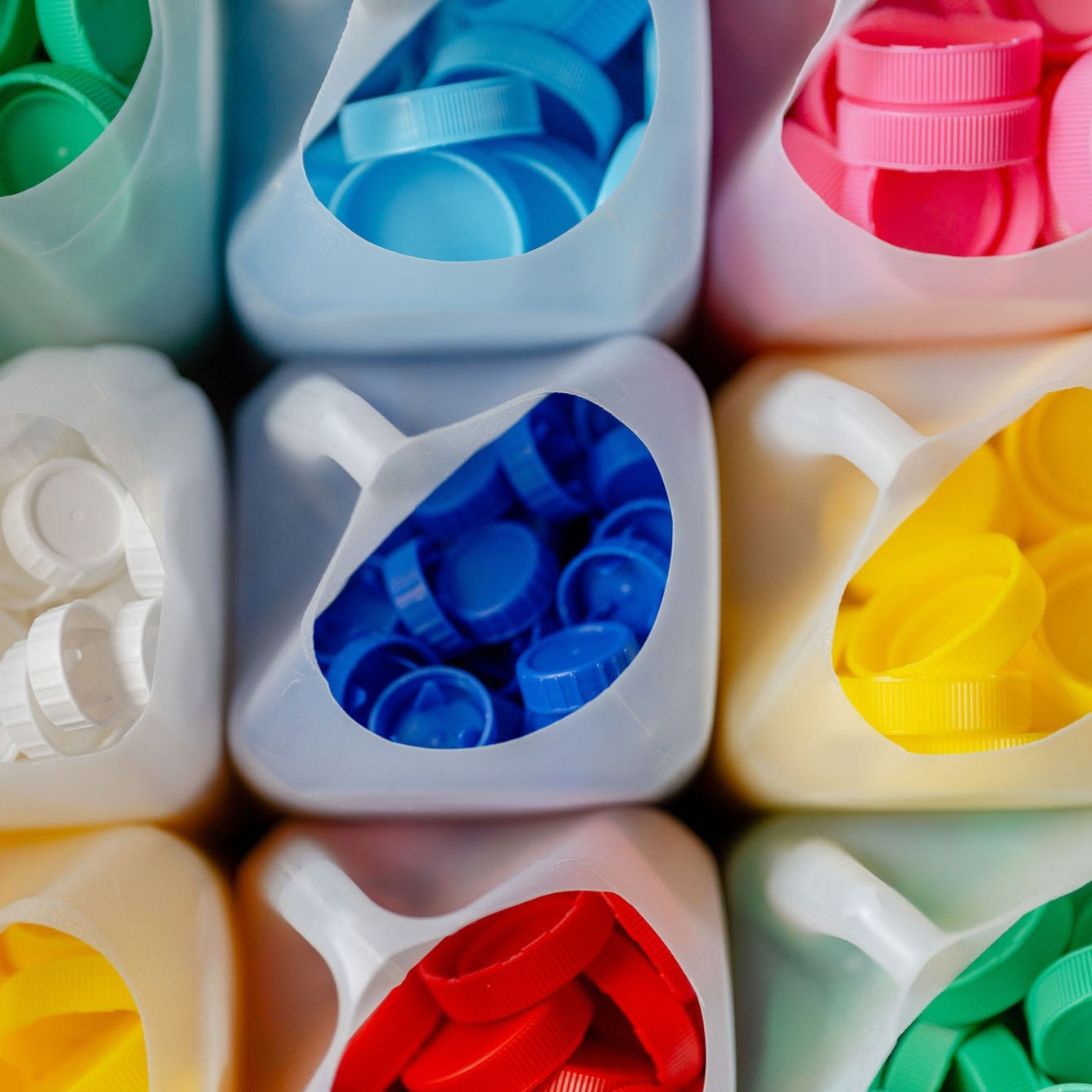
That is where BRAD (Banish Recycling and Diversion) comes in. BRAD is our by-mail recycling program for the small, fiddly, hard-to-recycle bits that fall outside kerbside and outside the container deposit scheme. Plastic bottle top lids are exactly the sort of item BRAD was built for, and they can go in a BRAD box rather than landfill. Metal bottle tops, including metal beer caps, are not on the BRAD accepted list, so check your council's guidance for those.
When you are ready to send yours in, a BRAD Pre-paid Label covers both the return postage and the recycling, and Sydney locals can use a BRAD Sydney Drop-Off instead. Plastic bottle top lids are washed, sorted by colour and shredded here in Sydney, and some come back as Recycled Shredded Plastic Flakes. Do check what BRAD currently accepts before you pack, as the list is updated regularly.
What BRAD does not take is anything in the e-waste bucket: phones, chargers, cables, fairy lights or lithium-ion batteries. Those go to dedicated e-waste collectors or Officeworks' Bring It Back scheme. Household batteries are also a no for BRAD, alkaline included, because of the fire risk in transit. Take those to a free B-cycle drop-off point, which you will find at major supermarkets around the country. Chip packets are a soft plastic, so they are not on the BRAD list either. Our guide to soft plastics recycling in Australia covers where those can go. BRAD does accept blister packs, toothbrushes, cosmetics, pens, and metal coffee pods (including Nespresso).
The clean workflow looks like this: bottles and cans to your state CDS for the 10 cent refund, plastic bottle top lids into your BRAD box, soft plastics to a supermarket or council soft plastics collection point if one is active in your area, and clean rigid recyclables to kerbside.
Eligible containers in more detail
What is always accepted
Aluminium soft drink and beer cans, glass beer and cider bottles, plastic water and soft drink bottles, juice poppers, flavoured milk cartons and most pre-mixed spirit cans. If the label has a "10c refund" mark with the matching state name, it is in.
What is sometimes accepted
Wine and spirit glass bottles are the big one. Queensland has accepted them since November 2023. Western Australia adds them from 1 July 2026, the Northern Territory expands to include them from mid-2026, and New South Wales, the ACT and South Australia are scheduled to follow from 2027 onwards. Until then, wine bottles in those states still go in your yellow-lid kerbside bin.
What is never accepted
Plain milk bottles (dairy, soy, oat, almond), cordial concentrate over 1 litre, containers over 3 litres, sachets and pouches in most states, anything without the 10c refund mark, and any container that has been crushed beyond the point where the barcode can be read.
Why does Australia run separate state schemes?
Container deposit law sits with the state, not the Commonwealth. South Australia legislated first in 1975 (scheme live in 1977), and the rest of the country took nearly half a century to catch up. Because each state legislated on its own, the operating model, the start date and the list of eligible containers all differ. The 10 cent refund became the unofficial national standard because South Australia set it.
The big picture is that Australia now has the most comprehensive container deposit coverage in the world. Tasmania's launch in May 2025 closed the last gap. Wine and spirits glass coverage is the next domino to fall, with five states expanding their accepted-containers list across 2026 and 2027.
Frequently asked questions
How does Containers for Change work?
You return an eligible drink container (150 mL to 3 L, with a 10c refund mark) to a refund point, and you get 10 cents back per container. Refund points include reverse vending machines, depots and bag-drop services. You can take the refund as cash, bank transfer, or donate it to a charity, school or sports club.
Is the refund really 10 cents in every state?
Yes. The refund is 10 cents per eligible container in every state and territory, from South Australia (the original 1977 scheme) through to Tasmania's Recycle Rewards (2025).
What is the difference between Return and Earn, Containers for Change and CDS Vic?
They are different brand names for the same idea, run by different operators. Return and Earn is New South Wales. Containers for Change is the name used in Queensland and Western Australia. CDS Vic is Victoria. The ACT, Northern Territory, South Australia and Tasmania all use plainer "Container Deposit Scheme" or "Recycle Rewards" branding. The 10c refund is identical.
Where can I find a containers for change refund point near me?
Use the postcode locator on your state scheme's website. Each state child guide on Banish (linked above) opens with a direct link to its operator's locator. TOMRA and Envirobank also each run national locator maps that cover most of the country.
Can I return wine and spirit bottles?
In Queensland, yes, and have been able to since November 2023. From 1 July 2026, you can return them in Western Australia and the Northern Territory. New South Wales, the ACT and South Australia start accepting them from 2027. Victoria and Tasmania have not announced a date yet. Until your state turns it on, wine and spirit bottles go in kerbside.
What do I do with bottle caps and labels?
The CDS does not refund bottle caps or loose labels. Plastic bottle top lids can go into a BRAD box instead, along with the other small hard-to-recycle items that kerbside and the CDS will not take. Metal bottle tops are not on the BRAD accepted list, so check your council's guidance for those.
Why is plain milk excluded?
The schemes were designed to reduce litter, and plain milk bottles tend to be consumed at home rather than on the go, so they rarely show up as litter. The Northern Territory is the first jurisdiction to add plain milk to its accepted list, from mid-2026.
Can I claim the refund on someone else's containers?
Yes. The refund belongs to whoever brings the container to the refund point. That is why community groups, charities, sports clubs and schools often run collection drives, and why neighbours sometimes pool their bottles for a single drop-off.
Recycle this with BRAD
The container deposit scheme refunds the bottle but not the lid, so send your plastic bottle top lids and other small hard-to-recycle bits to BRAD instead of landfill.